Chronic Wound Treatment
When healthcare professionals think of chronic wound treatment, minds may go straight to advanced wound dressings, medical devices, and closure rates. But as someone who has been both patient and clinician, wound care specialist Liezl Naude has learned that holistic wound healing is far more complex—and far more human—than traditional approaches suggest. A video of her presentation at EWMA 2025 can be found here.
Healing Beyond the Wound: How Innovation in Chronic Wound Treatment Supports the Whole Person
Liezl Naude RN, RM, BCUR, MCUR, AWCP – Wound Management Specialist, South Africa

In 2024, Naude developed Stevens-Johnson Syndrome en route to the U.S. She suffered burns over more than 31% of her body, lost all mucosal membranes, and entered a physical and emotional nightmare she never imagined she’d face. What followed was a long road through physical pain, psychological trauma, and a rediscovery of her own purpose as a wound management clinician. What helped her—what helps so many patients—was not just clinical expertise or protocols, but comprehensive wound care that addressed all aspects of well-being.
That’s why Dr. Peggy Swarbrick’s Eight Dimensions of Wellness (2006) resonate so deeply with Naude’s approach to modern wound care—and why innovative wound care technologies like NATROX® O₂ Continuous Topical Oxygen Therapy matter in evidence-based principals of wound care. These advances allow clinicians to think beyond the wound bed and into the full dimensions of a person’s healing journey.
1. Emotional Wellness in Chronic Wound Treatment
Emotional wellness, defined as the ability to manage emotions and cope with life’s challenges, plays a critical role in wound healing outcomes. Research demonstrates that more than 30% of chronic wound patients suffer from depressive symptoms or anxiety, directly affecting healing outcomes [1]. This psychological burden can create a cycle where poor emotional health delays healing, which in turn worsens emotional distress.
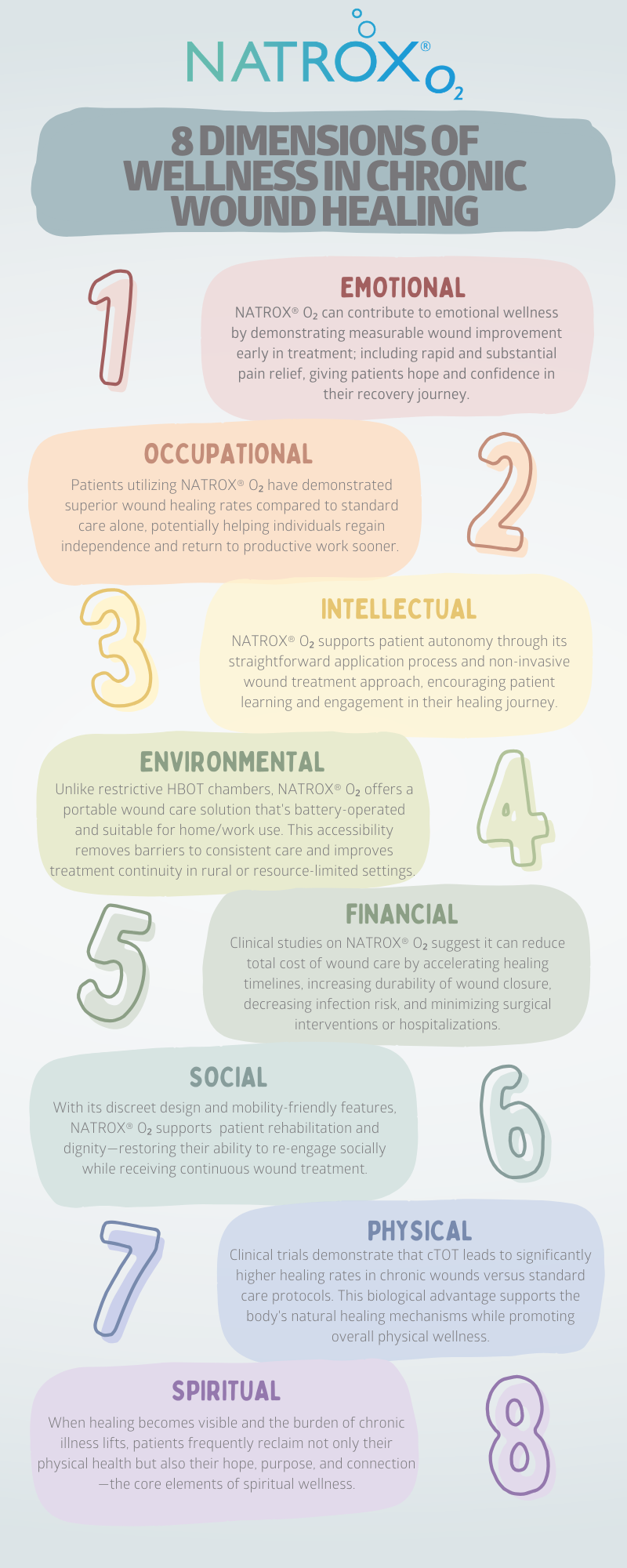
NATROX® O₂ can contribute to emotional wellness by demonstrating measurable wound improvement early in treatment; including rapid and substantial pain relief, giving patients hope and confidence in their recovery journey.
2. Occupational Wellness and Return to Productivity
Occupational wellness—the ability to return to work and contribute meaningfully to society—represents a crucial component of comprehensive wound care. Chronic wound conditions often lead to significant lost productivity and workplace challenges.
A comprehensive study revealed the substantial occupational impact of chronic wounds: 68.6% of patients were or had been on sick leave due to their wound condition. Additionally, 27.5% reported multiple sick leave episodes (more than three times total), 7.8% reduced their weekly working hours, and 3.9% faced job termination because of their wound [2].
Patients utilizing NATROX® O₂ have demonstrated superior wound healing rates compared to standard care alone, potentially helping individuals regain independence and return to productive work sooner [3].
3. Intellectual Wellness and Patient Empowerment
Intellectual wellness involves continuous learning and self-direction in healthcare decisions. When patients understand their treatment options and participate actively in chronic wound treatment, outcomes consistently improve. Dr. Windy Cole advocates for Shared Decision-Making (SDM) to help patients make informed and confident choices about their care [4].
NATROX® O₂ supports patient autonomy through its straightforward application process and non-invasive wound treatment approach, encouraging patient learning and engagement in their healing journey.
4. Environmental Wellness in Wound Care Access
Environmental wellness encompasses living in safe, accessible, and supportive environments. Factors like inconsistent electricity, limited mobility, or poor hygiene conditions can significantly impact wound healing progress.
Unlike restrictive hyperbaric oxygen chambers, NATROX® O₂ offers a portable wound care solution that’s battery-operated and suitable for home/work use. This accessibility removes barriers to consistent care and improves treatment continuity in rural or resource-limited settings [5].
5. Financial Wellness and Healthcare Economics
Chronic wounds impose a staggering economic burden, costing the U.S. healthcare system up to $96.8 billion annually, largely due to prolonged care requirements and complications [6].
Early clinical studies on NATROX® O₂ therapy suggest it can reduce total cost of wound care by accelerating healing timelines, increasing durability of wound closure, decreasing infection risk, and minimizing surgical interventions or hospitalizations [3, 11].
6. Social Wellness and Quality of Life
Patients with non-healing wounds frequently experience social isolation due to embarrassment, odor concerns, or mobility limitations. This social withdrawal can significantly impact overall well-being and healing outcomes.
Clinical research confirms that social support significantly improves wound healing outcomes, while isolation represents a risk factor for delayed healing [7]. The psychological benefits of maintaining social connections cannot be understated in comprehensive wound management.
With its discreet design and mobility-friendly features, NATROX® O₂ supports patient rehabilitation and dignity — restoring their ability to re-engage socially while receiving continuous wound treatment.
7. Physical Wellness and Biological Healing
Physical wellness encompasses physical activity, nutrition, and the body’s fundamental ability to function optimally. Oxygen therapy plays an essential role in collagen synthesis, angiogenesis, and bacterial defense—all critical elements of effective wound healing [8].
Clinical trials demonstrate that cTOT leads to significantly higher healing rates in chronic wounds versus standard care protocols [3,9]. This biological advantage supports the body’s natural healing mechanisms while promoting overall physical wellness.
8. Spiritual Wellness and Healing Purpose
Spiritual wellness provides patients with a sense of purpose and inner peace, which can be transformative during illness and recovery. This dimension often receives less attention in traditional chronic wound treatment but plays a vital role in holistic healing.
Studies suggest that patients with higher spiritual well-being report better coping skills and quality of life during recovery [10]. When healing becomes visible and the burden of chronic illness lifts, patients frequently reclaim not only their physical health but also their hope, purpose, and connection—the core elements of spiritual wellness.

Moving Forward with Innovative Chronic Wound Treatment
Innovation in chronic wound treatment isn’t merely about advanced medical devices—it’s about meaningful impact on patients’ lives. Advanced wound care technologies like NATROX® O₂ should be viewed not as shortcuts, but as bridges to whole-person wellness and comprehensive healing.
Naude challenges healthcare professionals, caregivers, and patients to consider:
- Are you treating the wound—or the whole person?
- Are you choosing wound care products that only close wounds—or that also open lives?
Because ultimately, chronic wounds are not endpoints. They can represent new beginnings—of transformation, empowerment, and healing across all eight dimensions of wellness.
Modern wound care innovation should always serve this broader purpose.
Watch the presentation from European Wound Management Association 2025 Conference in Spain.
Chronic Wound Treatment with NATROX O₂
References
References
- Renner R, Erfurt-Berge C. Depression and quality of life in patients with chronic wounds: ways to measure their influence and their effect on daily life. Chronic Wound Care Management and Research. 2017;4:143-151.
- Busch, D. A.-K., Methner, N., Azodanlou, D., Moelleken, M., Dissemond, J., Herthe Hübner, U., Przysucha, M., Kücking, F., Berking, C., & Erfurt Berge, C. (2025). Chronic wounds and employment: Assessing occupation related burden of patients with chronic wounds — Results of a pilot study. International Wound Journal, 22, e70372. https://doi.org/10.1111/iwj.70372
- Serena TE, Bullock NM, Cole W et al, 2021. Topical oxygen therapy in the treatment of diabetic foot ulcers: a multicentre, open, randomised controlled trial. J Wound Care 2021; 30: Suppl.5 S7-14.
- Shared Decision-Making in Wound Management. Available at: https://www.natroxwoundcare.com/resource/shared-decision-making-in-wound-management/
- NATROX® O₂ User Guide. Inotec AMD Ltd.
- Nussbaum SR et al. An economic evaluation of the impact, cost, and Medicare policy implications of chronic nonhealing wounds. Value Health. 2018;21(1):27–32.
- Detillion, C.E., Craft, T.K., Glasper, E.R., Prendergast, B.J. and DeVries, A.C. (2004) Social Facilitation of Wound Healing. Psychoneuroendocrinology, 29, 1004-1011.
- Gordillo GM, Sen CK. Evidence-based recommendations for the use of topical oxygen therapy in chronic wounds. Surg Clin North Am. 2003;83(3):731–744.
- Snyder RJ et al. A prospective, randomized, multicenter, controlled evaluation of topical oxygen for healing chronic wounds. Wound Repair Regen. 2016;24(6):924–934.
- Delgado-Guay MO et al. Spirituality and religiosity in palliative care. J Palliat Med. 2011;14(9):1107–1114.
- Al-Jalodi O, Kupcella M, Breisinger K, et al. (2022) A multicenter clinical trial evaluating the durability of diabetic foot ulcer healing in ulcers treated with topical oxygen and standard of care versus standard of care alone 1 year post healing. Int Wound J, 19(7):1-5.