Diabetic Foot Ulcer Treatment
Last updated:
Chronic diabetic foot ulcers (DFUs) remain a significant clinical challenge, especially when standard of care falls short. In a compelling lecture at EWMA 2025, Prof. Dr. José Luis Lázaro Martínez delivered a focused message: there is no bad therapy, only bad indications. His discussion centered on the importance of appropriate patient selection and timely intervention with Continuous Topical Oxygen Therapy (cTOT)— an adjunctive therapy increasingly recognized in modern protocols for diabetic foot ulcer treatment and recalcitrant neuroischemic wounds.
Indications of cTOT for DFUs: Closing the Gaps
Prof. Dr. José Luis Lázaro Martínez
DPM, MSc, PhD, FFPM RCPS (Glasg)
Lecturer at Complutense University, Madrid, Spain
Head of Diabetic Foot Unit
Director of the Diabetic Foot Research Group at Complutense University and Health Research Institute at San Carlos Teaching Hospital (Madrid), Spain
Chair, Diabetic Foot Committee, EWMA
Vice-Chairperson, Diabetic Foot Study Group (Europe)

Why Standard of Care Isn’t Always Enough
Despite adherence to offloading, revascularization, glycemic control, infection management, and local wound care, a large proportion of DFUs remain unhealed—only about 30% close within 6 months, according to a recent meta-analysis1. Many patients continue to receive outdated or low-evidence therapies which are ineffective in complex or neuroischemic wounds.
The Need for Evidence-Based Adjuncts in Diabetic Foot Ulcer Treatment
Prof. Lázaro Martínez challenged the traditional approach to wound care, highlighting that most DFU patients today are more complex than ever, often with a mix of ischemia, neuropathy, and impaired microcirculation. While macrovascular blood flow (transmission) may be restored through revascularization, the distribution of oxygen within the foot—especially in neuroischemic cases—remains compromised.
That’s where cTOT comes in.
Understanding cTOT’s Role
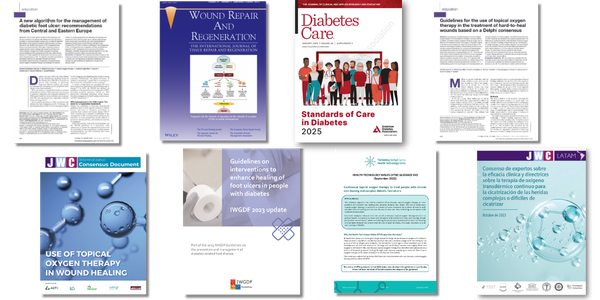
Once considered an experimental therapy, topical oxygen is now endorsed in international guidelines, including those from the International Working Group on the Diabetic Foot (IWGDF). Among the topical oxygen modalities available, NATROX® O₂—a Continuous Topical Oxygen Therapy—offers an evidence-backed, non-invasive adjunct for chronic wounds.
Clinical Indications: When to Use cTOT
Prof. Lázaro Martínez outlined specific clinical scenarios where cTOT demonstrates strong potential:
- Non-healing DFUs: When standard of care fails, cTOT is a logical next step.
- Neuroischemic ulcers: Ideal for patients with both poor macrovascular flow and microvascular dysfunction—these are often first-line indications for cTOT.
- After negative pressure wound therapy (NPWT): When deeper granulation is needed, cTOT serves as a valuable transition therapy post-NPWT.
- Exposed tendon or bone: Post-debridement wounds with exposed structures respond well to the oxygen-rich environment provided by cTOT.
- Post-amputation sites: Enhances closure and reduces complication risk in high-risk post-surgical wounds.
- Heel ulcers: These notoriously hard-to-heal ulcers benefit from improved oxygenation through cTOT.
| Diabetic Foot Ulcer Treatment Scenario | Role of cTOT in Diabetic Foot Ulcer Treatment |
| Non‑healing DFUs after 4 weeks → | Use as adjunctive therapy |
| Neuroischemic ulcers → | Consider cTOT early/first-line |
| Wounds with bone/tendon exposure → | Use cTOT to promote granulation |
| Transition from NPWT → | Seamless therapy transition to support closure |
| HBOT/Contraindications* → | Alternative therapy |
| Post‑amputation /heel wounds → | Enhance closure and reduce risk |
*Editor’s note, not originally included in EWMA presentation.
Case-Based Evidence
Through a series of clinical cases, Prof. Lázaro Martínez demonstrated remarkable wound healing trajectories using cTOT, including:
- Neuroischemic DFUs that healed in weeks after stagnation under standard of care.
- Full granulation over bone and tendon without the need for amputation.
- Wounds previously unresponsive to NPWT that showed accelerated healing under cTOT.
Final Thoughts: Closing the Gap in Diabetic Foot Ulcer Treatment
For clinicians treating diabetic foot ulcers (DFUs), particularly those complicated by ischemia, neuropathy, or surgical intervention, cTOT offers a critical tool to close the healing gap. As Prof. Lázaro Martínez emphasized, the therapy is not meant to replace best practices—but to enhance and extend the healing potential when standard treatments alone are insufficient.
The era of relying solely on passive dressings is over. It’s time to match active, evidence-based therapies to the right patients—and in many cases, that means integrating Continuous Topical Oxygen Therapy like NATROX® O₂ into your DFU treatment algorithm.
Diabetic Foot Ulcer Treatments with NATROX O₂
References
References:
- Coye TL, Bargas Ochoa M, Zulbaran-Rojas A, Martinez Leal B, Quattas A, Tarricone A, Chung J, Najafi B, Lavery LA. Healing of diabetic neuropathic foot ulcers receiving standard treatment in randomised controlled trials: A random effects meta-analysis. Wound Repair Regen. 2025 Jan-Feb;33(1):e13237.