Key Points
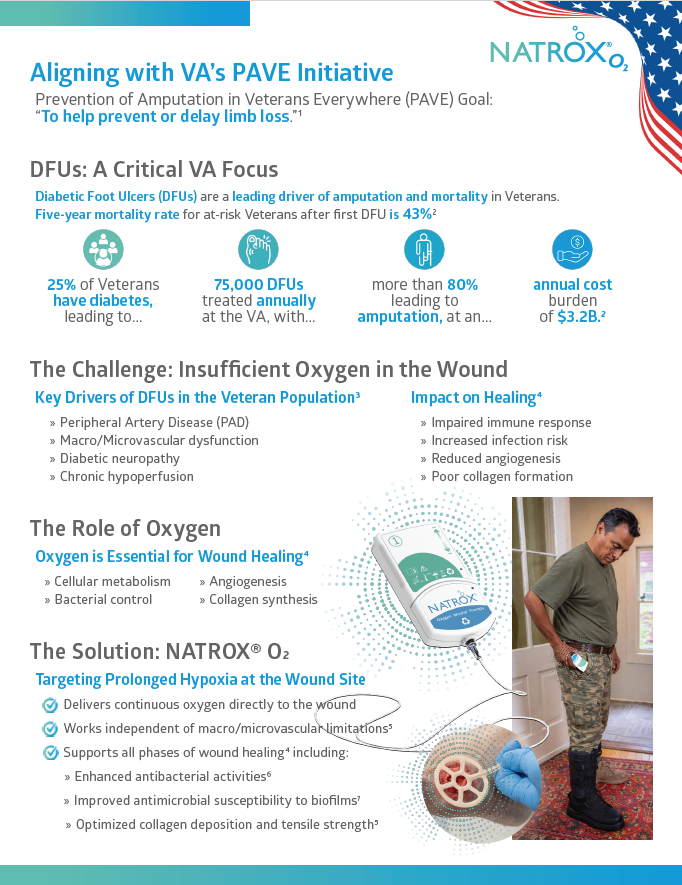
- 80% of nontraumatic amputations in the VA start with diabetic foot ulcers (DFUs)
- Hypoxia is a primary barrier to healing in high-risk DFUs
- Most DFUs involve comorbidities that limit oxygen delivery
- Continuous topical oxygen therapy (cTOT) delivers oxygen directly to the wound site
- NATROX® O₂ supports tissue repair, angiogenesis, and infection control
- NATROX O₂ aligns with VA PAVE goals of reducing amputation risk and improving outcomes
Topics Covered
- The burden of diabetic foot ulcers in the VA population
- Pathophysiology of DFUs: hypoxia, PAD, and impaired healing
- The role of oxygen in wound healing and tissue repair
- Limitations of standard of care in hypoxic wounds
- Continuous Topical Oxygen Therapy (cTOT) as an adjunctive solution
- Clinical evidence supporting cTOT
- Case studies in high-risk DFUs and limb preservation
- Alignment with VA initiatives, including PAVE
References
- U.S. Department of Veterans Affairs. (n.d.). Prevention of amputation in Veterans everywhere (PAVE).
https://www.va.gov/north-texas-health-care/programs/prevention-of-amputation-in-veterans-everywhere/ - U.S. Department of Veterans Affairs. (n.d.). Reducing hospital admissions and amputation prevention: Remote temperature monitoring. VA Diffusion Marketplace.
https://marketplace.va.gov/innovations/reducing-hospital-admissions-and-amputation-prevention-remote-temperature-monitoring - Li WW, Carter MJ, Mashiach E, et al. (2017) Vascular assessment of wound healing: a clinical review.Int Wound J, 4(3):460-9. https://pmc.ncbi.nlm.nih.gov/articles/PMC7950183/
- Cole W, Nair HKR, Nigwekar SU, et al. (2025) Mechanistic insights and international use cases of continuous topical oxygen therapy in wound management. Wounds Int, 16(4):18-25. https://www.natroxwoundcare.com/wp-content/uploads/mechanistic-insights-international-cases-cTOT-wound-mgmt.pdf
- Gordillo GM, Sen CK. (2009) Evidence-based recommendations for the use of topical oxygen therapy in the treatment of lower extremity wounds. Int J Low Extrem Wounds, 8(2):105-11. https://pubmed.ncbi.nlm.nih.gov/19443899/
- Gupta S, Mujawdiya P, Maheshwari G, et al. (2022) Dynamic Role of Oxygen in Wound Healing: A Microbial, Immunological, and Biochemical Perspective. Arch Razi Inst, 77(2):513-23. https://pmc.ncbi.nlm.nih.gov/articles/PMC9548270/
- Ball C, Jones H, Thomas H, et al. (2024) Impact of continuous topical oxygen therapy on biofilm gene expression in a porcine tissue model. J Wound Care, 33(9):702-707. https://www.natroxwoundcare.com/wp-content/uploads/DFSG-2024-cTOT-Biofilm-gene-expression.Ex-vivo-model.Web_.pdf
- Serena TE, Bullock NM, Cole W, et al. (2021) Topical oxygen therapy in the treatment of diabetic foot ulcers: a multicentre, open, randomised controlled trial. J Wound Care, 30(Sup5):s7-14. https://www.natroxwoundcare.com/wp-content/uploads/JoWC_2021_30_05_SerenaRCT_Web-Lic.pdf
- Al-Jalodi O, Kupcella M, Breisinger K, et al. (2022) A multicenter clinical trial evaluating the durability of diabetic foot ulcer healing in ulcers treated with topical oxygen and standard of care versus standard of care alone 1 year post healing. Int Wound J, 19(7):1-5. https://onlinelibrary.wiley.com/doi/epdf/10.1111/iwj.13789
- Cole W, Woodmansey E. (2024) Monitoring the Effect of Continuous Topical Oxygen Therapy with Near-Infrared Spectroscopy: A Pilot Case Series in Wound Healing. Wounds, 36(5):154-9. https://www.natroxwoundcare.com/wp-content/uploads/Cole_Monitoring-the-Effect-of-cTOT-with-NIRS.pdf
- American Diabetes Association Professional Practice Committee. (2026) 12. Retinopathy, Neuropathy, and Footcare: Standards of Care in Diabetes-2026. Diabetes Care, 49(Suppl 1):S268-S72. https://diabetesjournals.org/care/issue/49/Supplement_1
- NATROX O₂ DFU cost and health impact analysis on the US VA Health System – York Health Economic Consortium 2025. Data on file.
- Lee A. (2021) Continuous topical oxygen therapy- improving healing in the diabetic foot. [Poster] DFCon: San Francisco. https://www.natroxwoundcare.com/wp-content/uploads/DFU-Poster.pdf
- Bailey-Davies S, Quddus A, Younis N, et al. (2024) Promoting Healing of Chronic Wounds Using Continuous Topical Oxygen Therapy with Chronic Limb Threatening Ischaemia Having No Revascularisation Option: a Case Study. [Poster] Wounds UK: Harrogate. https://www.natroxwoundcare.com/wp-content/uploads/cTOT-Chronic-Limb-Threatening-Ischaemia-1.pdf