Help Refine Coverage Language for Reimbursement of Topical Oxygen Therapy
Now is the time to act for patient access to clinically proven TOT
The DME MACs are currently accepting written comments on the proposed LCD, and your help is needed to strengthen and refine clear and practical coverage for patient care. In the proposed LCD (DL33797), the “Topical Oxygen Therapy” coverage is added as “Group V” on page 4 in the PDF.
We have carefully reviewed the proposed LCD (DL33797) along with the Alliance of Wound Care Stakeholders and identified key opportunities to strengthen and clarify the coverage language. We believe these thoughtful refinements can help ensure the final published LCD reflects current clinical evidence and practice, supporting patient access.
If you treat patients with diabetic foot ulcers, your clinical perspective is particularly valuable.
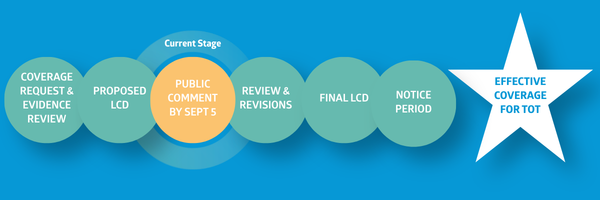
As you review the proposed LCD language, determine if you identify any gaps in coverage. Submit your relevant comments and recommendations. If you’d like a template for your comments, use these steps to guide you:
- Update bracketed fields in the sample letter template with your information and clinical experience.
- We’ve outlined key concerns in the template letter for you to consider. Select the concerns most relevant to your practice. Focus on points that you feel most strongly about.
- Personalize each section with brief examples from your clinical experience where indicated. Specific patient scenarios, including photos (de-identified) are particularly impactful.
- Submit before the comment period deadline of September 5, 2026.
- Submit via this email address: TOTRecon@noridian.com
- Use this Subject Line: Oxygen and Oxygen Equipment (DL33797)
- Keep a copy of your submitted comments for your records.
- Consider encouraging colleagues who treat DFU patients to submit their own comments.
Thank you for advocating for our patients and advancing care options.
How to Write a Letter to the DME MACs
Date: [Insert Date]
To: DME MAC
Re: Public Comment on Draft Local Coverage Determination (DL33797)
Oxygen and Oxygen Equipment (Group V: Topical Oxygen Therapy)
Provider Name: [Insert Name, Credentials]
Specialty: [Insert Specialty]
Practice Name: [Insert Practice/Institution Name]
NPI: [Insert NPI Number]
Address: [Insert Practice Address]
Phone: [Insert Phone Number]
Email: [Insert Email Address]
Dear Medical Directors and LCD Review Committee,
I am writing as a [insert specialty] provider who treats Medicare beneficiaries with diabetic foot ulcers (DFUs) to provide feedback on the draft Local Coverage Determination for Oxygen and Oxygen Equipment, specifically the Group V provisions addressing topical oxygen therapy (TOT).
I support the establishment of Medicare coverage for TOT as an adjunctive treatment for nonhealing DFUs. This coverage determination is consistent with the American Diabetes Association 2026 Standards of Care, the International Working Group on the Diabetic Foot 2023 guidelines, and the Wound Healing Society 2024 guidelines.
However, I have concerns about several provisions that, as currently written, may restrict access for my patients and create unnecessary administrative burden.
[INSTRUCTION TO PROVIDER: Select the concerns below that are most relevant to your practice. You may submit all eight or focus on those you feel most strongly about. Personalize each section with your own clinical experience where indicated.]
You can help ensure proper access with this proposed LCD. Act now and let your voice be heard!
Public comments are due September 5, 2026.
The DME MACs will also hold a public meeting on August 26, 2026, for those who would like to listen to the discussion surrounding the proposed LCD. You can register using this link.
Key Concerns
Weigh in on these points to ensure patient access to the healing power of Topical Oxygen Therapy.
20% Wound Area Reduction Threshold
A reduction in ulcer area (length × width) of ≥ 20% from the most recent month’s measurement
______________________________
Why it’s Flagged
The requirement for ≥20% wound area reduction each month is overly rigid and not supported by validated wound healing prediction literature. The established benchmark as validated by Sheehan et al. (Diabetes Care, 2003) and endorsed by the ADA and IWGDF, is a 50% wound area reduction at 4 weeks as a predictor of healing at 12 weeks. A monthly 20% threshold has not been validated as a predictor of healing failure.
Recommended Language
Replace the ≥20% monthly threshold with documented clinically meaningful progress metrics such as, but not limited to (modeled on CAMP/CTP LCDs):
- reduction in ulcer area
- Increased granulation / epithelial advancement; decreased slough/necrotic tissue
- Decreased exudate volume, improved quality
- Edge contraction, decreased depth/undermining, improved periwound skin
- Pain reduction, improved ambulation, increased tissue oxygenation (NIRS/spectral imaging)
- Remove or substantially revise the classification-scale alternative.
Blanket Infection Exclusions
Topical oxygen therapy will be denied as not reasonable and necessary if one or more of the following is present:
1. Diabetic foot ulcer-related:
a. Abscess; or,
b. Osteomyelitis; or,
c. Joint sepsis; or,
d. Gangrene; or
______________________________
Why it’s Flagged
The exclusion of all patients with “abscess, osteomyelitis, joint sepsis, or gangrene” does not distinguish between active untreated infection and infection that is being adequately managed.
Recommended Language
Topical oxygen therapy shall not be covered in the presence of active, untreated abscess, osteomyelitis, joint sepsis, or gangrene. Beneficiaries whose infection has been appropriately treated and is under clinical management may be eligible for topical oxygen therapy upon resumption of optimized diabetic foot ulcer care.
DVT/Malignancy Exclusions
Limb involvement on the same side as the DFU in the past three (3) months of:
a. Deep vein thrombosis; or,
b. Malignancy
______________________________
Why it’s Flagged
The 3-month lookback exclusion for deep vein thrombosis or malignancy on the same limb does not distinguish between active conditions and those that have been adequately treated or resolved. A patient with a fully anticoagulated, resolved DVT or a completely excised cutaneous malignancy should not be excluded from TOT coverage.
Recommended Language
Topical oxygen therapy shall not be covered in beneficiaries with active deep vein thrombosis or active malignancy involving the affected limb. A history of successfully treated deep vein thrombosis or malignancy shall not, by itself, constitute a contraindication to coverage.
Monthly In-Person Requirement
For continued coverage of topical oxygen therapy…beyond the initial first month…the treating practitioner must complete an in-person visit with the beneficiary for each month of additional coverage.
______________________________
Why it’s Flagged
The requirement for monthly in-person visits for continued TOT coverage creates a significant burden for both practice and patients.
Recommended Language
For continued coverage of topical oxygen therapy beyond the initial month, the treating practitioner shall document continued medical necessity through an in-person or telehealth evaluation, or through documentation in the beneficiary’s medical record demonstrating ongoing clinical benefit and adherence to optimized diabetic foot ulcer care. An in-person visit shall not be required more frequently than every ninety (90) days unless clinically indicated.
Bundled Payment Structure for TOT Consumables
The LCD states that “oxygen reimbursement is a bundled payment for both inhaled and topical modalities” and that “all options, supplies and accessories are considered included in the monthly rental payment.” TOT requires specialized, single-use oxygen delivery systems and wound-specific dressings that must be replaced with each dressing change. These consumables are fundamentally different from the low-cost nasal cannulae and tubing used in inhaled oxygen therapy.
______________________________
Why it’s Flagged
Bundling TOT consumables into an oxygen rental payment calibrated for stationary concentrators creates a reimbursement mismatch that may make it economically unviable for suppliers to provide TOT to my patients effectively creating a coverage denial through inadequate reimbursement. I request establishment of separate HCPCS supply codes for TOT-specific consumables.
“Optimized Diabetic Foot Ulcer Care” Is Not Defined
The LCD repeatedly references “optimized diabetic foot ulcer care” without providing a definition within the LCD itself. This creates ambiguity for providers regarding what documentation is required to demonstrate that standard care has been attempted and failed.
FAQs
Does Medicare cover topical oxygen therapy today?
Not yet under this proposed policy—but an important step toward coverage has occurred.
Today, the existing Medicare DME coverage policy states that topical oxygen delivery systems are not considered reasonable and necessary for coverage. On July 23, 2026, the DME MACs published a proposed new coverage policy that would establish Medicare coverage criteria for topical oxygen therapy for patients with diabetic foot ulcers.
The policy is still in the proposal stage, which means it has not yet changed Medicare coverage or reimbursement.
What are the DME MACs?
The Centers for Medicare & Medicaid Services (CMS) contracts with private organizations called Medicare Administrative Contractors, or MACs, to help administer Medicare.
The DME MACs specifically handle Medicare claims and coverage policies for durable medical equipment, prosthetics, orthotics and supplies.
DME MACs develop coverage policies that determine when certain equipment or therapies are considered medically reasonable and necessary for Medicare beneficiaries.
What is an LCD?
LCD stands for Local Coverage Determination.
An LCD is a Medicare coverage policy developed by a MAC. It explains whether an item or service will be covered and the clinical circumstances that must be met for Medicare to consider it reasonable and necessary.
Why is the public comment period so important?
Because the policy is not final yet.
The DME MACs are specifically asking stakeholders to review the proposed coverage criteria and provide feedback. They can revise the proposed LCD after reviewing the written comments they receive.
This means clinicians have an opportunity right now to explain how the proposed requirements align—or may not align—with real-world wound care.