National Health Service (NHS) Cost Effectiveness of NATROX® O₂
Last updated:
NATROX® O₂ Saves £9,904 per Person with Diabetic Foot Ulcers — Whilst Improving Outcomes
Authors: Lisa Thomas RGN, David Fernandez — NATROX® Wound Care, Cambridge, UK
SUMMARY
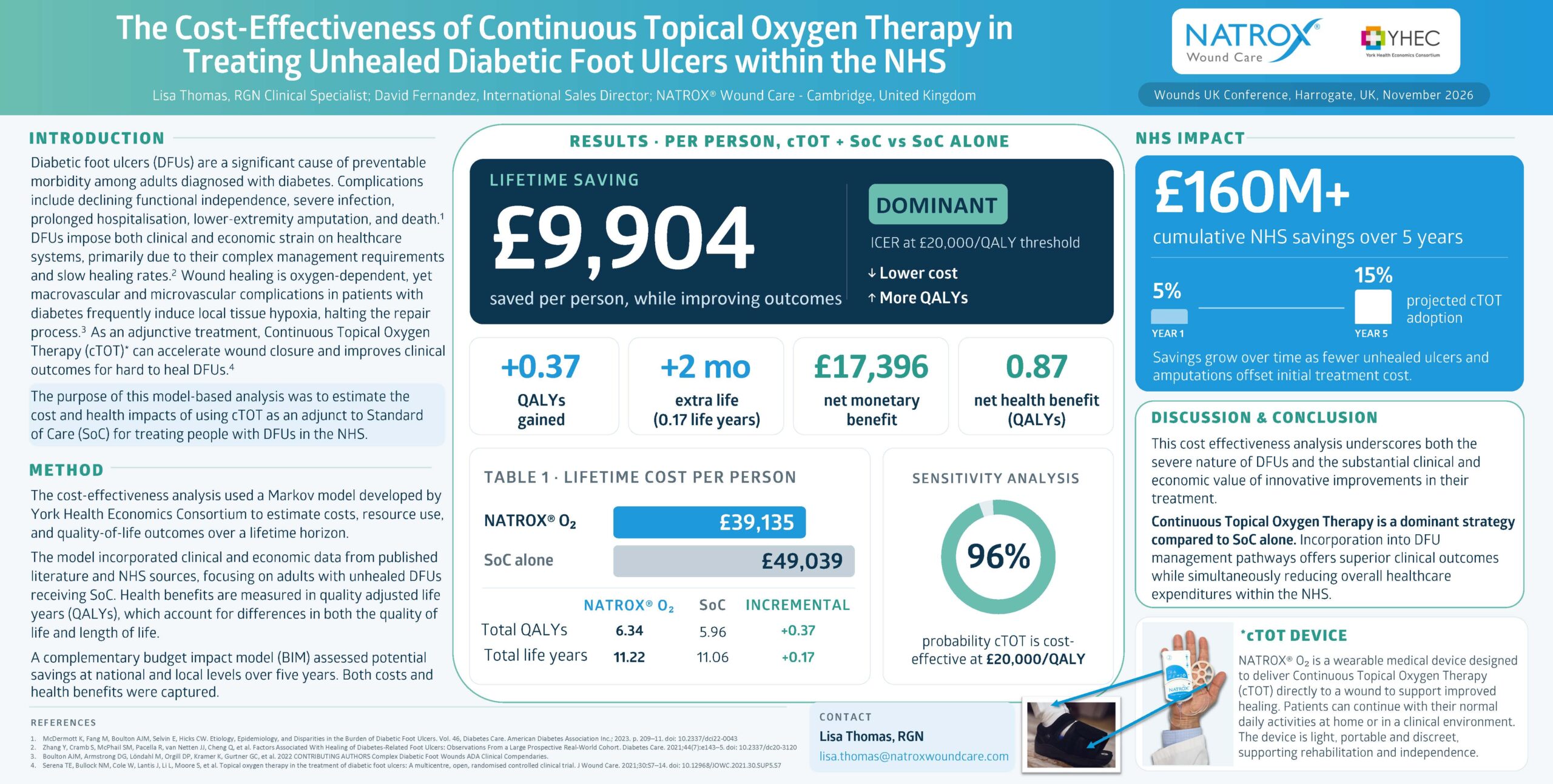
An independent health economic model provisioned by YHEC shows that adding Continuous Topical Oxygen Therapy (cTOT) to standard wound care for unhealed diabetic foot ulcers (DFUs) in the NHS is dominant — it costs less and delivers better outcomes. At the National Institute for Health and Care Excellence (NICE) £20,000/QALY willingness-to-pay threshold, there is a 96% probability cTOT is cost-effective, with cumulative NHS savings projected at £160M+ over five years.
Why DFU Cost-Effectiveness Matters for the NHS
Diabetic foot ulcers are a significant source of preventable morbidity amongst adults living with diabetes. Complications include declining functional independence, prolonged hospitalisation, lower-extremity amputation, and death. DFUs impose both clinical and economic strain on healthcare systems, primarily due to complex management requirements and slow healing rates.
Wound healing is oxygen-dependent, yet macrovascular and microvascular complications in patients with diabetes frequently cause local tissue hypoxia — halting the repair process. As an adjunct treatment, Continuous Topical Oxygen Therapy (cTOT) can accelerate wound closure and improve clinical outcomes for hard-to-heal DFUs.
This model-based analysis estimated the cost and health impacts of adding cTOT to Standard of Care (SoC) for adults with unhealed DFUs in the NHS, using a validated Markov model developed by York Health Economics Consortium (YHEC).
Key Results
Lifetime Cost per Person: cTOT + SoC vs SoC Alone
“Continuous Topical Oxygen Therapy is a dominant strategy compared to SoC alone. Incorporation into DFU management pathways offers superior clinical outcomes while simultaneously reducing overall healthcare expenditures within the NHS.”
Study Information
Type: Health economic model
Model: Markov model (YHEC)
Horizon: Lifetime
Perspective: NHS payer
Population: Adults with unhealed DFUs
Comparator: cTOT + SoC vs SoC alone
ICER: Dominant
PSA confidence: 96% at £20,000/QALY
Conference: Wounds UK, Harrogate, Nov 2026

Probabilistic Sensitivity Analysis: 96%
96% Probability cTOT is Cost-Effective. The probabilistic sensitivity analysis (PSA) tested uncertainty across all model inputs simultaneously. In 96 out of 100 simulations, cTOT with SoC was cost-effective compared to SoC alone at the NICE £20,000/QALY willingness-to-pay threshold. This exceptionally high confidence level reflects the robustness of the economic case across a wide range of clinical scenarios.
Projected NHS Savings at Scale
A complementary budget impact model assessed potential savings at national and local NHS levels over a five-year horizon. As adoption grows from 5% in Year 1 to 15% by Year 5, cumulative savings exceed £160 million — driven by reduced hospitalisation, fewer amputations, and lower long-term wound management costs.
About NATROX® O₂
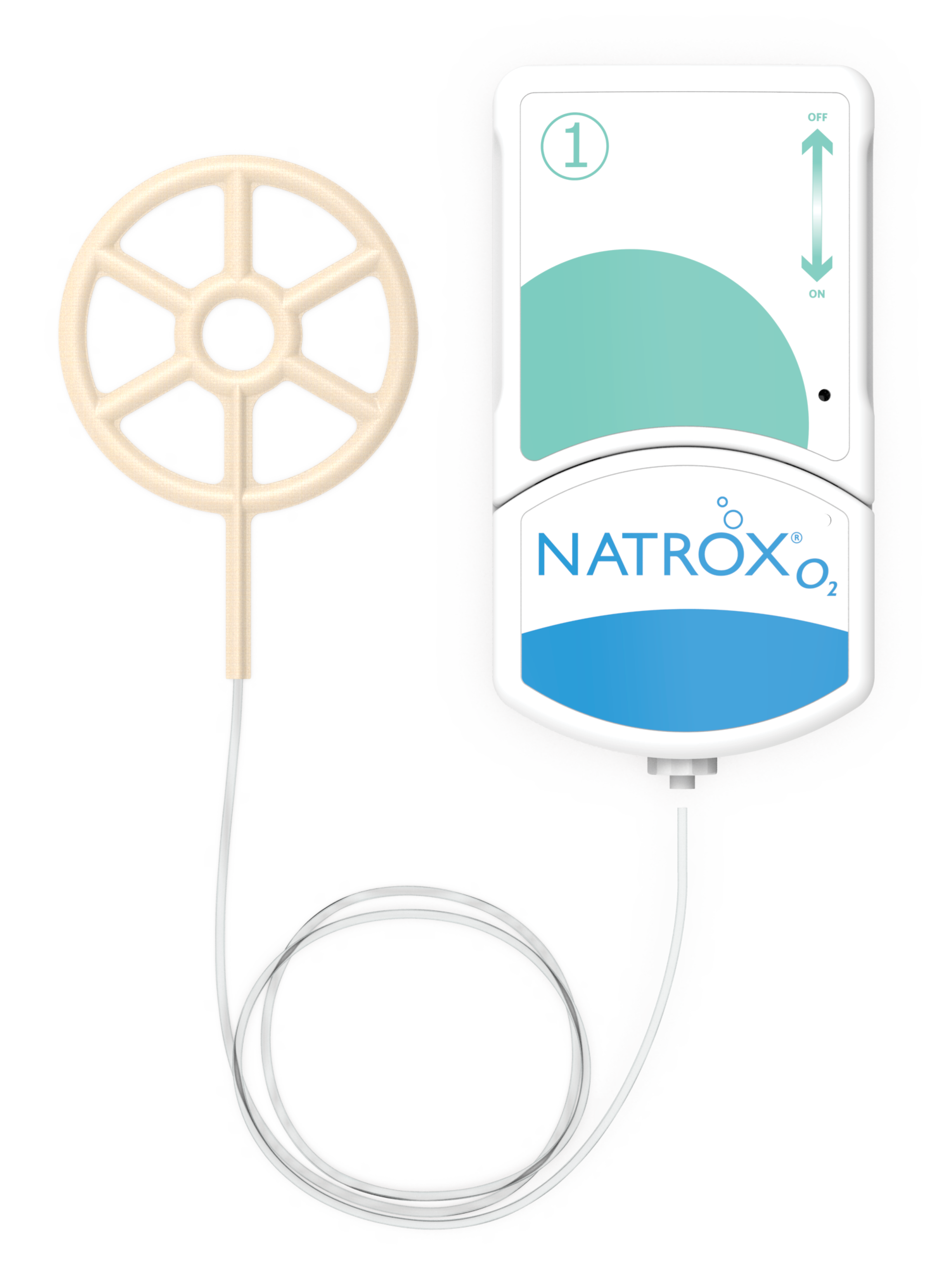
NATROX® O₂ consists of two components: the Oxygen Generator (OG) and the Oxygen Delivery System (ODS). Together they deliver a continuous, low-flow supply of supplemental oxygen directly to the wound bed 24 hours a day.
Oxygen Generator (OG)
- Simple, battery-operated device — delivering continuous oxygen at 11 ml/hr
- Rechargeable batteries — one in use while the other charges
- Wearable — patients remain mobile during therapy
- Lightweight and discreet — fits in a pocket
- Silent — no alarms to disturb sleep
Oxygen Delivery System (ODS)
- Sterile, single-use wound interface oxygen delivery system
- Soft and pliable — conforms to the wound’s anatomical location
- Used as an adjunct to standard of care including compression and total contact casting
- “Wheel” design optimises oxygen flow and diffusion across the wound bed
- Connects to the OG via a twist-and-lock attachment
Frequently Asked Questions
What does “dominant” mean in health economics terms?
A dominant strategy is one that is both less costly and more effective than the comparator — in this case, cTOT costs less per patient over a lifetime whilst producing more QALYs. A dominant result is the strongest possible outcome in a cost-effectiveness analysis; there is no trade-off to consider at the NICE threshold.
How does this compare to the NICE £20,000/QALY threshold?
NICE typically approves interventions costing below £20,000–£30,000 per QALY gained. As a dominant strategy, cTOT has a negative ICER — it saves money whilst gaining QALYs — placing it well within NICE’s acceptability range. The net monetary benefit of £17,396 per patient confirms this directly.
Who developed the model and what data sources were used?
York Health Economics Consortium (YHEC), an independent health economics consultancy affiliated with the University of York, developed the Markov model. The model incorporated clinical and economic data from published literature and NHS sources, focusing on adults with unhealed DFUs receiving standard NHS care.
Is there clinical trial evidence supporting this analysis?
Yes. The model draws on the Serena et al. (2021) multicentre, open, randomised controlled trial published in the Journal of Wound Care, which demonstrated the clinical effectiveness of topical oxygen therapy in DFU treatment. Full references are listed below.
How is NATROX® O₂ procured within the NHS?
NATROX® O₂ is available through NHS Supply Chain and NHS Shared Business Services. Your procurement or wound care lead can place orders through these frameworks. For queries about NATROX® O₂, contact info@natroxwoundcare.com