How the VA Can Save Over $1.2 Billion on Diabetic Foot Ulcer Care
Last updated:
Cost Effectiveness of Continuous Topical Oxygen Therapy for Unhealed Diabetic Foot Ulcers within the United States Veterans Health Administration
Poster Authors: Alexander Skinner | Windy Cole, DPM, CWSP, Director of Wound Care Research, Kent State University College of Podiatric Medicine | Nancy Stahulak, Vice President US Sales & Global Marketing, NATROX® Wound Care
SUMMARY
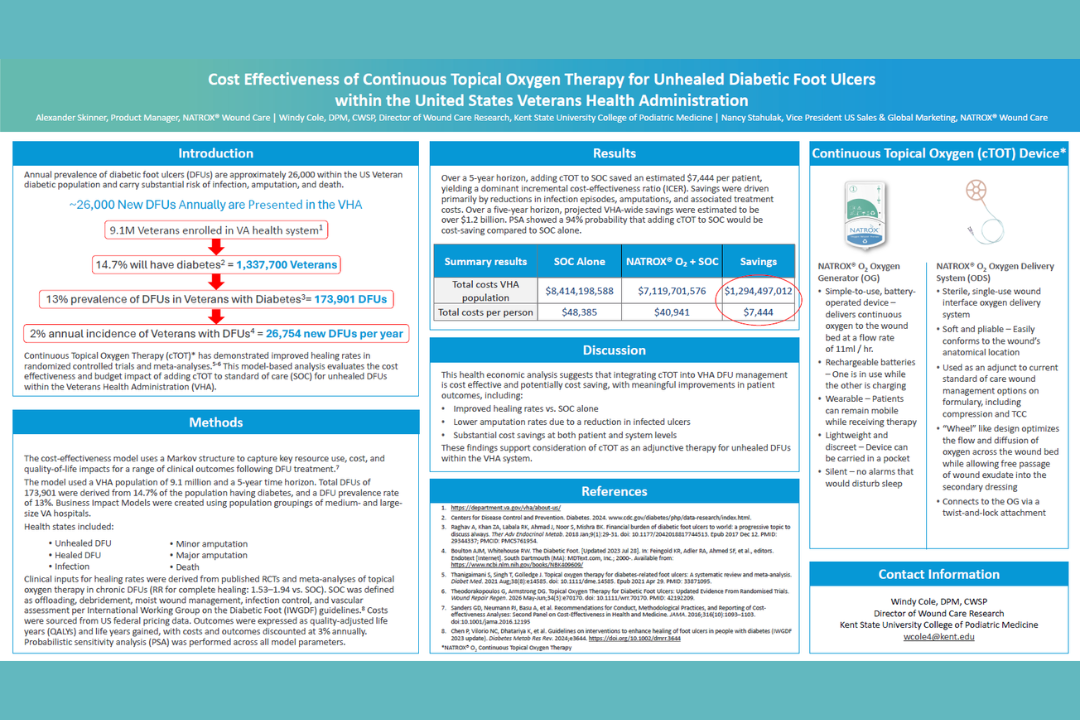
This health economic analysis evaluated the cost effectiveness and budget impact of adding NATROX® O₂ Continuous Topical Oxygen Therapy (cTOT) to standard of care for unhealed diabetic foot ulcers (DFUs) within the US Veterans Health Administration (VHA). Over a 5-year horizon, adding cTOT saved an estimated $7,444 per patient — driven by reductions in infection episodes, amputations, and associated treatment costs — and was cost-saving with 94% probability in probabilistic sensitivity analysis.
Why Diabetic Foot Ulcers Are a Critical Problem in the VHA
Approximately 26,000 new diabetic foot ulcers (DFUs) are diagnosed each year within the US Veteran diabetic population. DFUs carry substantial risk of infection, amputation, and death — and represent a significant, growing cost burden to the VHA system.
Continuous Topical Oxygen Therapy (cTOT) has demonstrated improved healing rates in randomized controlled trials and meta-analyses. This model-based analysis was conducted to evaluate whether adding cTOT to standard of care is not only clinically effective but cost-effective and cost-saving at the system level for the VHA.
How the Analysis Was Conducted
The cost-effectiveness model used a Markov structure to capture key resource use, cost, and quality-of-life impacts for a range of clinical outcomes following DFU treatment. The model incorporated a VHA population of 9.1 million with a 5-year time horizon. Business Impact Models were created using population groupings representative of medium- and large-size VA hospitals.
Health States Modeled
- Unhealed DFU
- Healed DFU
- Infection
- Minor amputation
- Major amputation
- Death
Clinical inputs for healing rates were derived from published RCTs and meta-analyses of topical oxygen therapy in chronic DFUs (relative risk for complete healing: 1.53–1.94 vs. standard of care). Standard of care was defined as offloading, debridement, moist wound management, infection control, and vascular assessment per IWGDF guidelines. Costs were sourced from US federal pricing data.
Outcomes were expressed as quality-adjusted life years (QALYs) and life years gained, with costs and outcomes discounted at 3% annually. Probabilistic sensitivity analysis (PSA) was performed across all model parameters.
Results
Adding cTOT to standard of care saved an estimated $7,444 per patient over a 5-year horizon, yielding a dominant incremental cost-effectiveness ratio (ICER) — meaning cTOT both improved outcomes and reduced costs compared to standard of care alone.
Savings were driven primarily by reductions in infection episodes, amputations, and associated treatment costs. Over a five-year horizon, projected VHA-wide savings were estimated to be over $1.2 billion.
Probabilistic sensitivity analysis showed a 94% probability that adding cTOT to standard of care would be cost-saving compared to standard of care alone — demonstrating robust confidence in the economic conclusion across a range of model assumptions.
Bottom line: For every patient treated with NATROX® O₂ cTOT instead of standard of care alone, the VHA is projected to save $7,444 — primarily by preventing infections and amputations that are far more costly to treat than the therapy itself.
Clinical and Economic Implications
This health economic analysis suggests that integrating NATROX® O₂ cTOT into VHA DFU management is cost effective and potentially cost saving, with meaningful improvements in patient outcomes. The three key drivers of savings are:
- Improved healing rates— cTOT demonstrated a relative risk for complete healing of 1.53–1.94 compared to standard of care alone, based on published RCT and meta-analysis data.
- Lower amputation rates— by reducing infected ulcers, cTOT reduces the downstream cascade that leads to minor and major amputations — among the most costly and debilitating outcomes in DFU care.
- Substantial cost savings at both patient and system levels— $7,444 per patient and over $1.2 billion projected VHA-wide over 5 years.
These findings support consideration of NATROX® O₂ cTOT as an adjunctive therapy for unhealed DFUs within the VHA system, and more broadly for any payer or health system managing a significant population of Veterans or patients with chronic diabetic foot wounds.
About the NATROX® O₂ Device
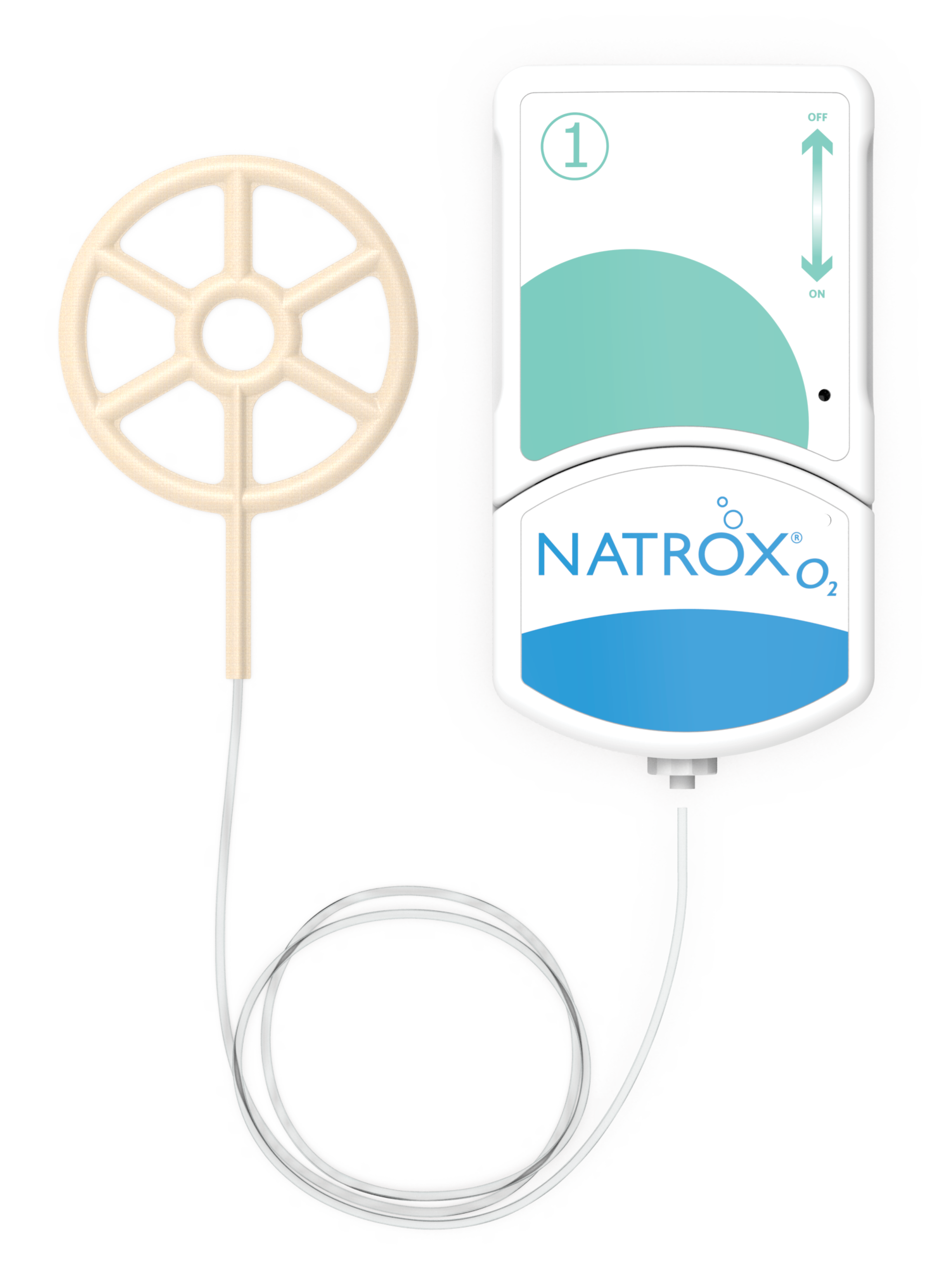
NATROX® O₂ consists of two components: the Oxygen Generator (OG) and the Oxygen Delivery System (ODS). Together they deliver a continuous, low-flow supply of supplemental oxygen directly to the wound bed 24 hours a day.
Oxygen Generator (OG)
- Simple-to-use, battery-operated device delivering continuous oxygen at 11 ml/hr
- Rechargeable batteries — one in use while the other charges
- Wearable — patients remain mobile during therapy
- Lightweight and discreet — fits in a pocket
- Silent — no alarms to disturb sleep
Oxygen Delivery System (ODS)
- Sterile, single-use wound interface oxygen delivery system
- Soft and pliable — conforms to the wound’s anatomical location
- Used as an adjunct to standard of care including compression and TCC
- “Wheel” design optimizes oxygen flow and diffusion across the wound bed
- Connects to the OG via a twist-and-lock attachment
What This Means for VA Administrators and Budget Decision-Makers
For VA administrators and health system leaders responsible for managing diabetic foot ulcer care costs, this analysis offers a clear economic case for adding NATROX® O₂ cTOT to standard treatment protocols.
The core finding is straightforward: treating unhealed diabetic foot ulcers with NATROX® O₂ in addition to standard of care costs less over five years than standard of care alone — not because the device is inexpensive, but because it prevents the complications that are far more expensive to treat. Infected ulcers, minor amputations, and major amputations each carry substantial direct treatment costs, downstream rehabilitation costs, and long-term quality-of-life impacts. By improving healing rates, cTOT reduces how many patients progress to those states.
At the patient level, the projected saving is $7,444 per person over five years — a reduction from $48,385 to $40,941 in total per-patient costs. At the system level, projected VHA-wide savings exceed $1.2 billion over the same horizon. Probabilistic sensitivity analysis across all model inputs confirmed a 94% probability that this conclusion holds — providing a level of confidence appropriate for formulary and procurement decision-making.
The model was built using US federal pricing data, IWGDF clinical guidelines for standard of care definition, and healing rate inputs from published RCTs and meta-analyses. It was structured to reflect the actual population groupings of medium- and large-size VA hospitals, making the projections directly applicable to VHA budget planning.
For facilities treating high volumes of Veterans with diabetes, the cost offset from reduced amputations and infections alone is projected to exceed the cost of the therapy — making NATROX® O₂ cTOT not just a clinical upgrade, but a financially sound addition to the standard of care.
This poster was presented at SAWC Fall 2026 in Las Vegas, Nevada.
Frequently Asked Questions — cTOT Cost Effectiveness in the VA
Is Continuous Topical Oxygen Therapy cost-effective for the Veterans Health Administration?
Yes. A health economic analysis using a Markov model with a 5-year horizon found that adding NATROX® O₂ Continuous Topical Oxygen Therapy (cTOT) to standard of care for unhealed diabetic foot ulcers in the VHA is cost-effective and cost-saving. This means it both improves patient outcomes and reduces total costs compared to standard of care alone. Probabilistic sensitivity analysis showed a 94% probability that cTOT is cost-saving vs. standard of care alone.
How much could the VA save by adding cTOT to standard diabetic foot ulcer care?
The analysis projects savings of $7,444 per patient over a 5-year horizon when cTOT is added to standard of care. Across the full VHA diabetic foot ulcer population — estimated at 173,901 patients — projected VHA-wide savings exceed $1.2 billion over five years. Savings are driven primarily by reductions in infection episodes, amputations, and the high treatment costs associated with those complications.
Does NATROX® O₂ reduce amputation rates in Veterans with diabetic foot ulcers?
Yes. The model found that adding cTOT to standard of care reduces amputation rates by decreasing the number of infected ulcers — infection being a primary driver of minor and major amputations in Veterans with diabetes. Both minor and major amputation were modeled as health states, and cTOT’s improved healing rates reduced progression into these outcomes compared to standard of care alone.
How confident is the evidence that cTOT saves money?
The probabilistic sensitivity analysis (PSA) — which tests the model across a full range of assumptions for every input parameter simultaneously — showed a 94% probability that adding cTOT to standard of care is cost-saving compared to standard of care alone. This is a high level of confidence for a health economic model and reflects the consistency of the clinical evidence base underlying the analysis.
What clinical evidence supports the healing rates used in this model?
Clinical inputs for healing rates were derived from published randomized controlled trials and meta-analyses of topical oxygen therapy in chronic diabetic foot ulcers. The relative risk for complete healing with cTOT versus standard of care alone ranged from 1.53 to 1.94 across the studies included — meaning patients receiving cTOT were 53–94% more likely to achieve complete healing compared to those receiving standard of care alone.
Is NATROX® O₂ available through the VA health system?
NATROX O₂ cTOT is covered nationally for patients who use their VA benefits for wound care at a VA facility, Military Treatment Facility, and/or within the VA’s Community Care Network.
NATROX O₂ is now easily ordered through the Spartan Medical Veterans First Contracting Program VFCP-38 U.S.C.§8127(d).